A studio of my own? Yes please! Then again…

For a very long time, in fact probably since I first dipped my hands in slip, I pined for my own studio. The autonomy of it appealed. So did the flexibility of being able to pop in an out of my own place when I wanted. And (this is a bit of a man thing) there’d be all that lovely kit; the tools and the bottles, buckets and kilns that I could shout are “Mine! They are all mine.”. But then… Oo-er. There’s the cost.

In recent years, I’ve occasionally pondered over the complete studio packages being offered, often at reasonable enough prices, it has to be said, by potters who are retiring, and I’ve thought, “yeah, I reckon I could cram all of that into my shed”. But for a potter who cannot work eight hours a day almost every day, the numbers just don’t add up.

I would have to rewire my shed with industrial cabling to handle umpteen amps of power, which would probably mean a three phase supply. Nope I don’t fully understand it either, but I know gthe outflow from my coffers would be catastrophic. And the price per kilowatt hour of the sparky stuff has risen by some 50% over the last five years or so. After capital costs, I think it would cost over £100 a week just to keep my kilns glowing. Then there is plumbing and drainage to be installed, which would be a one-off cost, but it would be a damned big one.

And there is a sort of Catch 22 about all of this: to justify splashing out all the money needed to create my own studio, I’d need to use it intensively. And the more I use it, the more it would cost. I know that would mean churning out endless mugs. They are good sellers, the best way to make money, and I like them.But there is more to pottery than mugs. I could take in a student. Rent out some space to a budding potter. Yeah, but I know how it goes: if you are managing a pottery and people, forget about making your own pots.

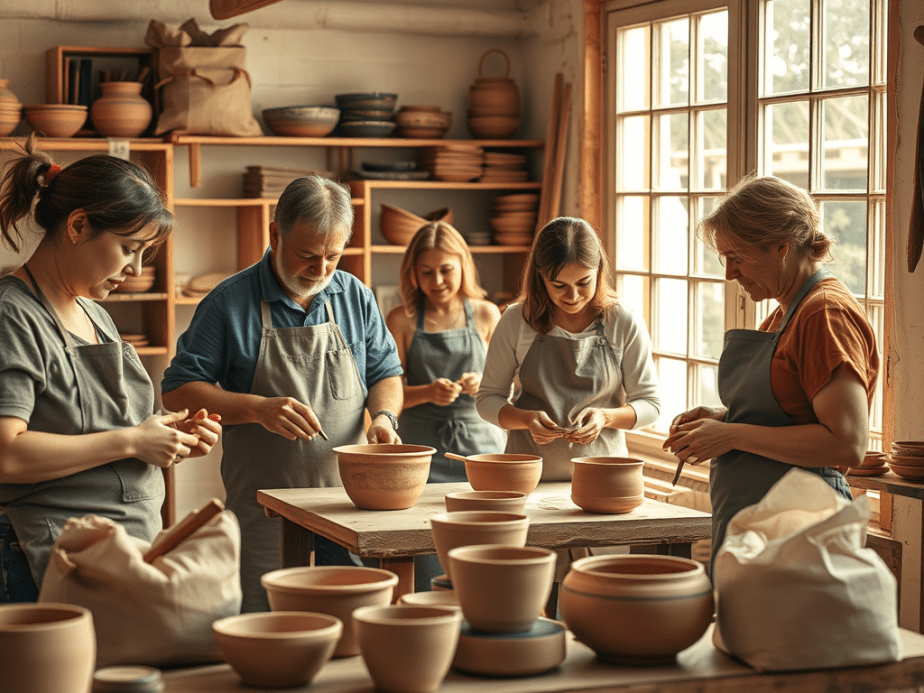
So, while there is still a part of me that would like to paddle my own studio-shaped canoe, that part is much diminished, compared to the part of me that likes what I do now. That is rent time and space in a big studio in Kilburn run by a nice guy and populated by a dozen or more other potters, all of whom are now friends.

We do more than rub along well. We share our skills and knowledge; give feedback on each other’s work, and commiserate each other when something emerges as mud-brown blob, rather than the golden-hued vessel we had imagined. We’ll sit down for lunch together, and talk of things other than pottery for a bit. None of that would happen in my vastly expensive garden shed.

Renting time and space in a large studio means that at the end of the day, I can throw my clay-caked tools into my tool box, grab the gorgeous creations that have emerged from four huge shared kilns, and go home. When I return later in the week, the glaze buckets will be topped up, there will be fresh bags of clay by the wedging table. I’ll whistle a happy tune as I take my seat at my favourite wheel, and concentrate on creation.

Did someone say they’re making coffee?

A Quiet Time of Contemplation and Ceramic Creativity

Two covid lockdowns and a brief period between them when we were theoretically allowed to return to something like normal life but were effectively still housebound, has been bad for my ceramics productivity.

Potters who are lucky enough to live above their studios or work in their garden sheds may hardly have noticed a difference; indeed their production has probably increased. But my family lives in a west London flat, and I share a studio at Kingsgate Workshops in Kilburn. At least I used to share that studio. Because most of my family are considered highly vulnerable to the damned virus, I have had to sit at home, pondering pots more than making them.

But recently I’ve been thinking about what that isolation and reduced activity really means. This has not been an entirely bad period. Not by a long chalk. I had become a slightly lazy potter, making forms that were familiar to me and always doing it on the wheel. Pre-covid, I was really not taking enough time to think, look for inspiration and sketch new ideas. I didn’t realise how important such quiet time is.

I now cherish it. My sketch books are filling with ideas, and while I haven’t been able to use a wheel, I have returned to hand-building after years of eschewing it as the poor relation of the wheel.

Coiling, slabbing and pinching at the kitchen table are slow, methodical processes, but they are hugely versatile techniques for making pots, and they encourage contemplation. The relatively few pots I’ve produced in recent weeks are very pleasing. I wouldn’t have made them seated at that whizzing wheel in the studio. They sit on shelves in the flat, unfired, bone dry and delicate. A slight knock could destroy them. I’m looking forward to getting back to the studio, where my first task will be to glaze and fire them.

Meanwhile, I continue to sketch, look for ideas and create slowly. Things are changing, though. My friend Chris Bramble, a fabulous potter and sculptor who runs our studio, has kindly lent me a small electric wheel, and it is now sitting in the middle of our kitchen waiting for me to sit down to it, slap a ball of wedged clay onto the turntable and see if my throwing skills have faded at all.

“Come on, clay-boy,” it whispers. “You know you want to.” Well, I do, and I will, with great pleasure. But I hope I won’t simply return to frenetic less than imaginative production. I’ve enjoyed the slower pace of potting since covid became our uninvited guest. I realise now that ceramics and, I suppose, art generally are as much about contemplation and exploring new methods as they are about productivity.

We’ve all heard the wonderful news about the breakthrough in vaccine research, and, boy, is that welcome. We can now really start looking forward to a return to normal life, and that can’t come quickly enough. When I am back among my friends and colleagues at the studio, enjoying the chatter (which is not necessarily about ceramics), and the critical appreciation of each other’s work, I’ll look back on this period of enforced slowing-down with some fondness. I know I’m a better potter for it, and I may even be a better person.

The Ceramic Garden 2020

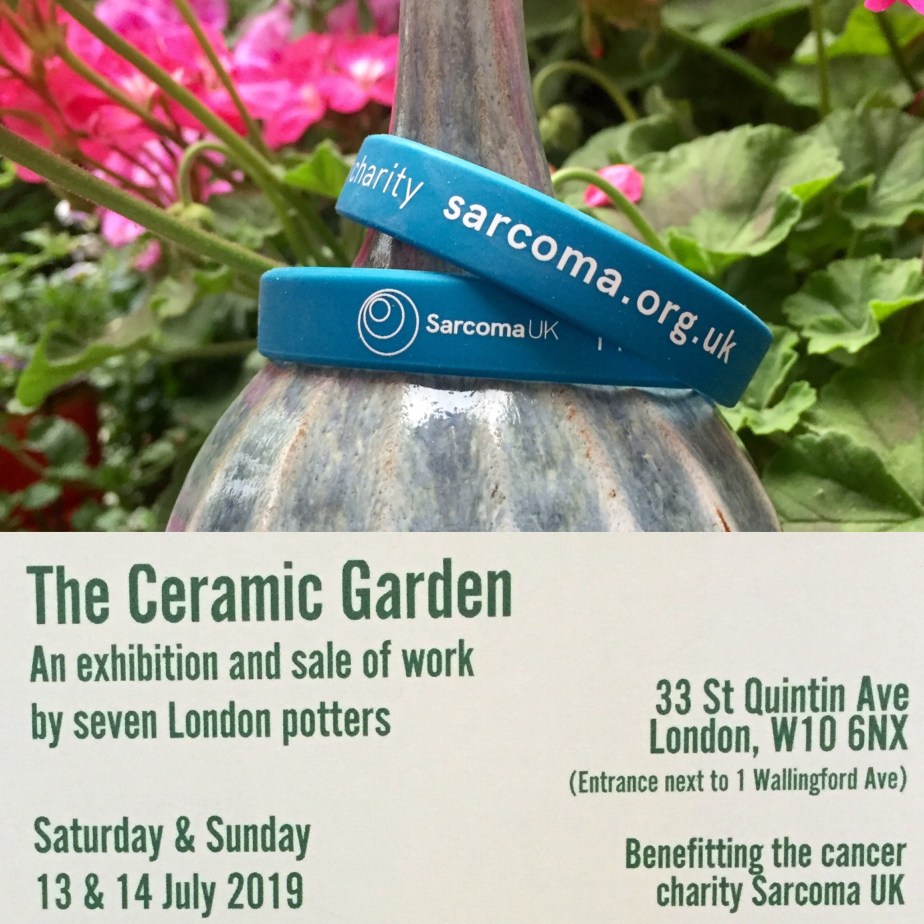
Last summer, over two wonderfully sunny days, our garden burst into life, not just with flowers, but with people and pots. Working with six other potters from west and north London, we created an outdoor exhibition, and perhaps a tradition.

Over that July weekend, we welcomed hundreds of neighbours and friends and even some people who had heard about the show and travelled from London’s outskirts. There were ceramic creations for all pockets, ranging from little yunomis and pinch pots priced at £10 to large sculptural pots that sold for hundreds of pounds.

Most importantly, both potters and visitors had a wonderful time. The icing on the cake, however, was the help we were able to give to one of my favourite charities, Sarcoma UK. A proportion of all sales was donated to this charity, which funds research into this rare form of cancer and supports those who are suffering from it. As my family has had a close encounter with sarcoma, I love being able to help Sarcoma UK.

We had been planning to have a second Ceramic Garden in June or July this year. But then . . . well, we all know what happened. Covid-19 or the corona virus, call it what you will, put paid to that plan. We haven’t given up, though. It may be possible to open up our garden to potters and those who love pots some time before summer sun has faded.

Even if Covid-19 does make a show this year impossible, we will not give up. The Ceramic Garden 2021 will be a celebration of the good times ahead.

If you’d like to be advised about plans for The Ceramic Garden and other exhibitions that I may be involved in, let me have your email address and/or phone number.

Stay safe, friends, and look to the future!

(Thanks to neighbour and friend Stephen Price for the above photo)